


What the April 2026 ADA Title II Deadline Means for School Districts
The U.S. Department of Justice’s April 2026 deadline for ADA Title II compliance isn’t just another regulatory checkbox—it’s a fundamental shift in how school districts must approach digital accessibility. Under the updated Title II regulations, all web content and mobile applications provided by state and local government entities, including K-12 school districts, must meet WCAG 2.1 Level AA standards. This means every PDF on your website, every form in your student information system, and every document in your online plan room must be accessible to students, parents, and staff with disabilities.
The scope is broader than most superintendents realize. Title II covers everything from enrollment forms and IEP documents to board meeting agendas and facilities blueprints. If a parent using a screen reader can’t navigate your school handbook PDF, or if a student with low vision can’t access your course catalog, your district is out of compliance. The deadline applies to all existing content, not just new materials created after April 2026, which means districts face a massive remediation challenge on top of their day-to-day operations.
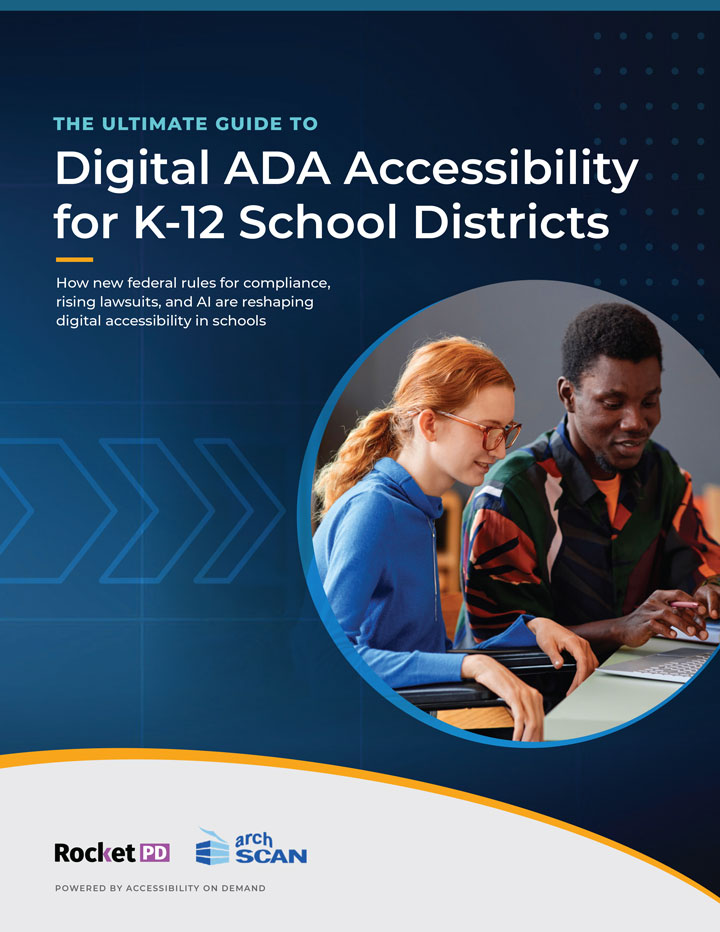
Free Guide
Download Now
No spam. Just actionable insights for district leaders.
Understanding Title II's Scope: What Must Be Accessible
ADA Title II compliance extends to every digital touchpoint between your district and the community. This includes district websites, parent portals, online registration systems, digital curriculum materials, and archived documents. The regulations don’t distinguish between “important” and “secondary” content—every PDF, every form, and every web page must meet accessibility standards. For districts with decades of digitized records, legacy plan room documents, and thousands of PDFs accumulated over years of operations, the remediation task can feel overwhelming.
The technical requirements are specific and non-negotiable. PDFs must include proper tagging, logical reading order, alternative text for images, form field labels, and correct heading structures. Scanned documents must be OCR-processed with human verification to ensure accuracy. Complex documents like architectural drawings, historical microfiche conversions, and technical specifications require specialized remediation approaches that automated tools alone can’t handle. Many districts discover that 30-50% of their digital content requires some level of accessibility work, and 10-20% needs comprehensive professional remediation.
This is where understanding your full document landscape becomes critical. Before you can remediate thousands of PDFs, you need to know what you actually have. A proper document audit identifies not just the volume of files, but their complexity, current accessibility status, and remediation priority. Some districts find that while they have 10,000 PDFs on their website, only 2,000 are actively used, while others discover critical student-facing documents that were never properly digitized in the first place.
Implementation Strategies: From Quick Fixes to Comprehensive Solutions
School districts approaching the 2026 deadline have options that range from immediate self-service remediation to full-scale enterprise document management projects. The right approach depends on your district’s size, technical capacity, document complexity, and long-term accessibility goals. Most districts will need a combination of solutions rather than a one-size-fits-all approach.
For straightforward documents like student handbooks, district policies, and board meeting minutes, automated remediation platforms can deliver fast, cost-effective results. These AI-powered tools handle the bulk of accessibility tagging, reading order corrections, and metadata creation at scale. A district can often remediate hundreds of simple PDFs in days rather than months, getting immediate wins on high-visibility, frequently-accessed content. However, automation works best on well-structured, text-based PDFs—the cleaner the source document, the better the automated results.
Complex documents tell a different story. Architectural drawings, engineering plans, historical records converted from microfiche, and documents with intricate tables or scientific notation often exceed what automated tools can handle reliably. These require human expertise to ensure proper tag structure, meaningful alternative text for technical diagrams, and accurate reading order in multi-column layouts. For districts with significant facilities documentation, legacy archives, or specialized technical content, professional document remediation services become essential. The key is knowing which documents need which approach—and having partners who can handle both.
The most successful districts treat April 2026 not as a one-time compliance sprint, but as the start of an ongoing accessibility program. This means establishing workflows for remediating new documents as they’re created, training staff on accessible document creation, implementing quality assurance processes, and building relationships with remediation partners who can scale support as needs evolve. A district that remediates 5,000 PDFs by April 2026 but continues creating inaccessible documents afterward hasn’t truly solved the problem—they’ve just bought temporary compliance.
Building Your District's Compliance Roadmap
The path to Title II compliance starts with honest assessment. Most districts don’t have a clear inventory of their digital content, don’t know which documents are accessed most frequently, and haven’t evaluated which files can be safely archived versus which must remain publicly accessible. A comprehensive document audit answers these questions and provides the foundation for a realistic remediation plan. Without this discovery phase, districts often waste time and budget remediating documents that could be archived or replaced with more accessible alternatives.
Your compliance roadmap should prioritize based on risk, usage, and complexity. Student-facing documents, parent communication materials, and legally required public notices should move to the front of the queue. Documents that are rarely accessed, are outdated, or can be replaced with more accessible formats may not need immediate remediation. The goal isn’t to remediate everything simultaneously—it’s to ensure your most critical content meets accessibility standards by April 2026 while building a sustainable process for everything else.
Resource planning matters as much as technical strategy. Calculate how many documents need remediation, estimate the time and cost for different remediation approaches, and build buffer time for quality assurance and unexpected challenges. Many districts underestimate the staff hours required for document preparation, review cycles, and stakeholder coordination. The districts that meet the deadline successfully are the ones that started planning in 2024 and 2025, not the ones scrambling in March 2026.
Taking the First Step Toward Compliance
The April 2026 deadline is firm, but the path to compliance doesn’t have to be chaotic. Districts that start now with a clear assessment of their document landscape, a prioritized remediation plan, and the right combination of tools and partners can meet the deadline without compromising educational quality or exhausting staff. The key is moving from awareness to action—understanding what needs to be done, having realistic timelines, and accessing the resources that match your district’s specific situation.
Whether your district needs to remediate a few hundred high-priority PDFs or transform a decades-old document archive into a fully accessible digital system, solutions exist at every scale and budget level. The resources above can help you take the next step, whether that’s running a free audit to understand your current state, accessing affordable remediation tools for straightforward documents, or connecting with specialists who handle complex document challenges that automated tools can’t solve. The deadline isn’t moving, but with the right approach, compliance is absolutely achievable.